
Give Your Child Security with Circle of Security
In raising children, many parents often feel puzzled—why does a child suddenly burst into tears for no apparent reason? Why, despite doing so much, does it still feel impossible to meet the child’s needs? Why do parent–child conflicts flare up even when you’re trying your best?
The key to these questions may lie in providing your child with enough felt safety. So how do we do that? Let’s explore the Circle of Security Parenting (COSP) approach.
Common Parenting Confusions
During a child’s development, parents encounter many baffling situations:
A child is happily playing one moment, then suddenly bursts into tears and wants a cuddle—the abrupt shift leaves caregivers at a loss.
You’ve poured so much effort into parenting and keep trying to meet every need, yet it still feels far from enough—as if you can never reach what your child expects.
The parent–child relationship should be warm and close, but in reality it can be tinged with disappointment, conflict, and frustration. Without a clear grasp of the child’s inner world and needs, distance can grow between you.
Children may have big reactions to “small” things; parents feel misunderstood and discouraged. This not only strains the relationship but can also be deeply disheartening.
Why Safety Matters
Research shows that a sense of safety is crucial to children’s growth. It’s a foundational pillar of brain development—only in a secure environment can children’s brains develop well and their thinking become more flexible and active. Safety also supports emotion regulation: secure children are better able to steady themselves rather than tip into anxiety or fear.
Exploration and learning likewise depend on safety. When children feel secure, they’re more willing to try new things and explore the unknown. And when facing stress or difficulty, children with a solid sense of safety show greater resilience and are more likely to seek help.
Children can truly play and learn only when they feel safe. Play is how they come to know the world; in a secure environment, they can fully express their nature, imagination, and creativity. Learning is similar: secure children face academic challenges with more confidence and take initiative. When difficulties arise, their internal safety allows them to ask for help rather than withdraw. In short, a sense of safety is essential for healthy development.
Learning Opportunity: Circle of Security Parenting
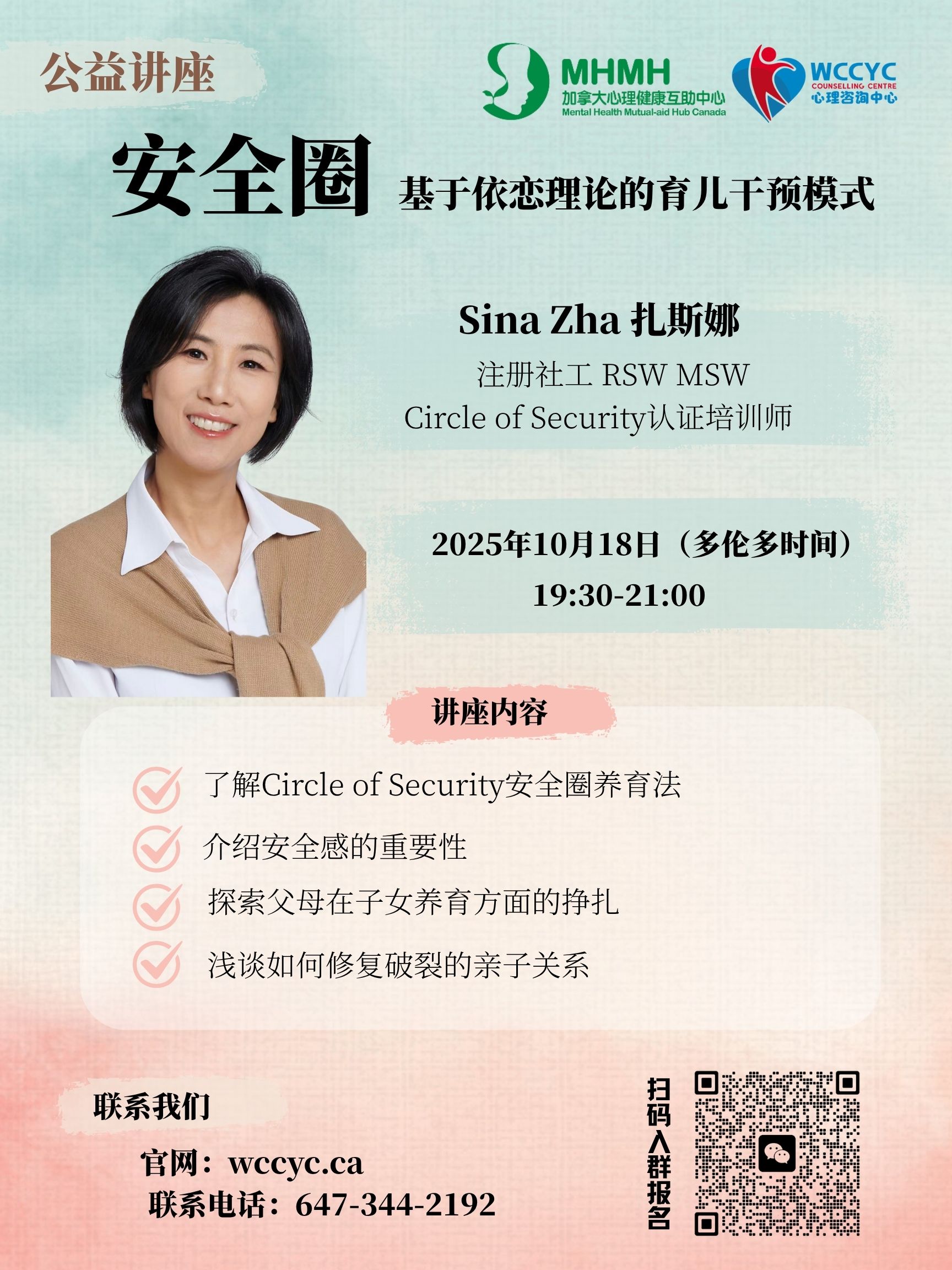
To help parents provide this sense of safety, WCCYC Counselling Centre and the Mental Health Mutual-Aid Hub Canada have invited Teacher Sina to present:
Toronto time: Oct 18, 7:30 p.m.
Beijing time: Oct 19, 7:30 a.m.
Topic: Circle of Security Parenting (COSP)
This session will use short film analyses, interactive discussions, and case studies to unpack the core of COSP. Short films let us directly observe children’s behaviors and needs in different situations; interactive discussion helps parents exchange insights and solutions; and real-case practice shows how COSP principles apply in daily life—how to tailor responses to your child’s specific cues. It’s a valuable chance to level up your parenting—don’t miss it!
What You’ll Gain
By joining this COSP learning session, you will learn how to:
Understand children’s true emotional needs and read their inner world.
Notice subtle changes—recognize signals of joy, anger, sorrow, and delight—to communicate and connect more effectively.
Build a stable, secure parent–child relationship—foster trust and provide enough felt safety.
Increase self-awareness and confidence—identify your strengths and growth areas as a caregiver, make targeted improvements, and meet challenges with assurance.
Repair ruptures—learn practical ways to reconnect after conflicts and make the relationship even stronger.
How to Register
It’s simple: scan the QR code on the poster to join the group and receive the Zoom details. In the group, you can interact with other parents and professionals and receive updates on upcoming parent groups and training series so you won’t miss any opportunities to learn.
Who Should Attend
This COSP learning session is suitable for a wide audience:
Parents, grandparents, and primary caregivers who play a central role in daily caregiving and want science-based, effective approaches.
Early-childhood educators who care for many children daily and want to enhance the quality of care and teaching.
Social workers who support diverse families and children and want practical tools to help.
Counsellors/therapists who can integrate COSP principles into professional practice for families in need.
Anyone seeking to better understand parent–child relationships and grow in parenting wisdom will benefit greatly.